

What is Turen?
Turen gives your organization visibility and control over AI coding agents like Claude Code, without slowing developers down. It runs a lightweight agent on each developer’s machine (macOS, Linux, or Windows) to enforce security rules, record sessions, and report telemetry.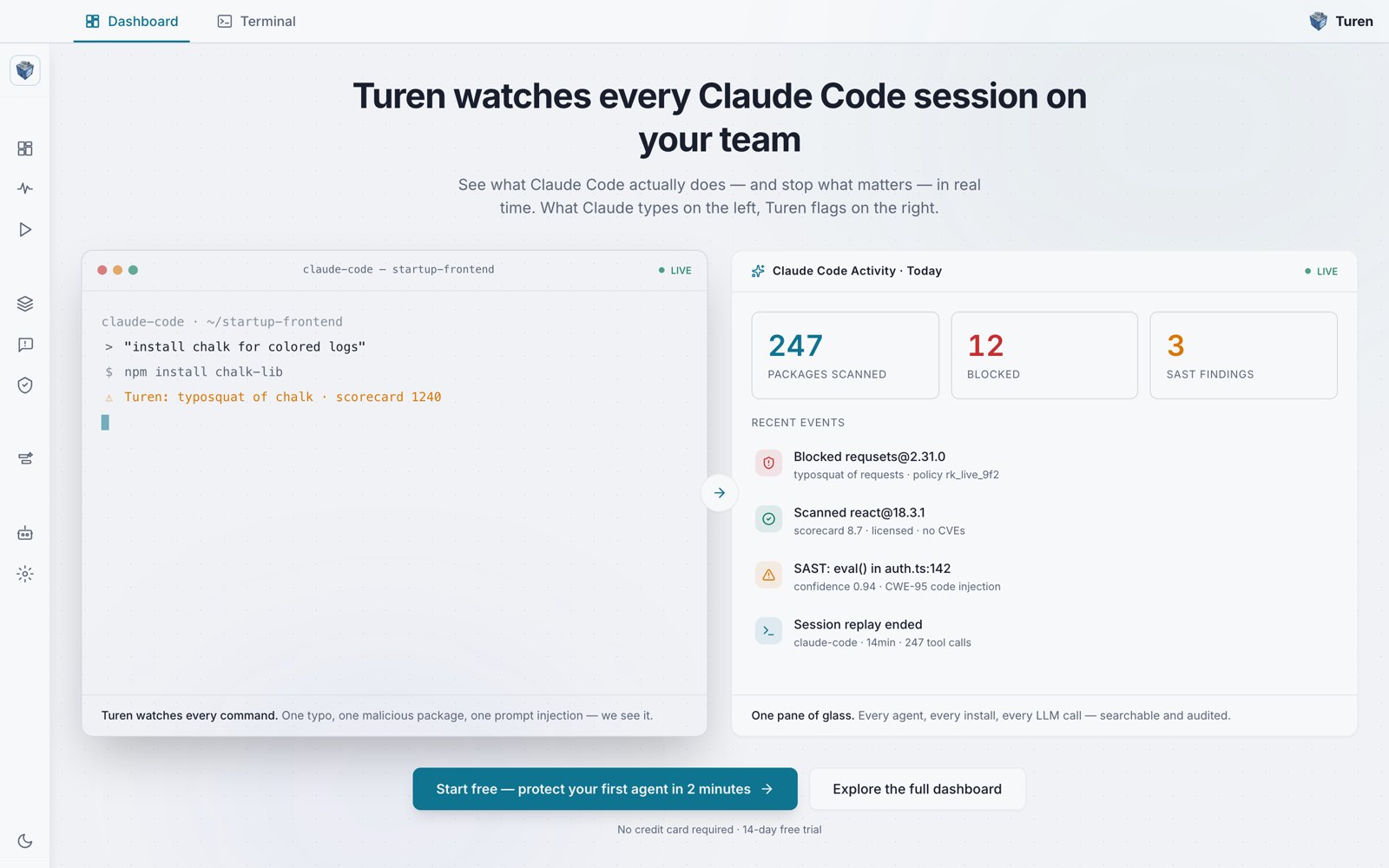
One pane of glass over Claude Code: the live session on the left, Turen's security findings (packages scanned, blocks, SAST findings) on the right.
Built-In Rules
Block dangerous commands, prompt injections, and secret exposure before they happen.
Session Replay
Record and replay every Claude Code session with full analytics and searchability.
LLM Telemetry
Track token usage, costs, latency, and model usage across your entire team.
Fleet Management
Monitor every agent machine, enforce policies centrally, and manage access at scale.
Who is Turen for?
Security teams who need guardrails around AI agent usage: blocking dangerous commands, detecting prompt injection attempts, and preventing secret leakage. Engineering leaders who want visibility into how AI agents are being used: what code is being generated, what tools are being invoked, and how much it costs. Compliance teams need an audit trail of every AI interaction for regulatory requirements.How it works
Turen deploys a lightweight agent on each developer’s machine. Every installer also bundles the Turen desktop app. The agent includes:- A background daemon that registers with your Turen organization, syncs policies, uploads session data, and derives usage telemetry from Claude Code’s session transcripts.
- Claude Code hooks that enforce your security rules locally: validating commands, gating package installs, and scanning code as it’s written.
Platform Support
Codex support is in preview. Session replay, LLM telemetry, package security,
and skill delivery behave the same as they do for Claude Code, and plan-limit
reporting and command, injection, and secret activity now surface for Codex
too. Local rule enforcement runs through Codex hooks but does not yet cover
every tool path, so treat it as an added layer of defense rather than a
complete boundary.
Ready to get started?
Set up Turen in under 5 minutes.